Introduction: Five procurement checks connect 2D identity, -196 C storage, contamination control, rack fit, and documentation for biobank sample traceability teams.
When a biobank evaluates a cryogenic vial manufacturer, the immediate question is often whether a tube can survive cold storage. The more consequential question is whether the sample can still be identified, retrieved, and defended as the same sample years later. A vial is part of a chain that includes accessioning, rack position, scanner output, inventory software, freezer movement, and the evidence needed when a specimen is selected for research or clinical development.
Barcode cryogenic vials make that chain more reliable only when the code, tube geometry, and storage workflow work together. A readable 2D code can reduce transcription risk, yet it cannot offset an incompatible rack, an unclear lot record, or a cap that is difficult to manage in a busy cold-room routine. For biobanks, the practical objective is stable identity under repeated handling, not an isolated barcode feature.
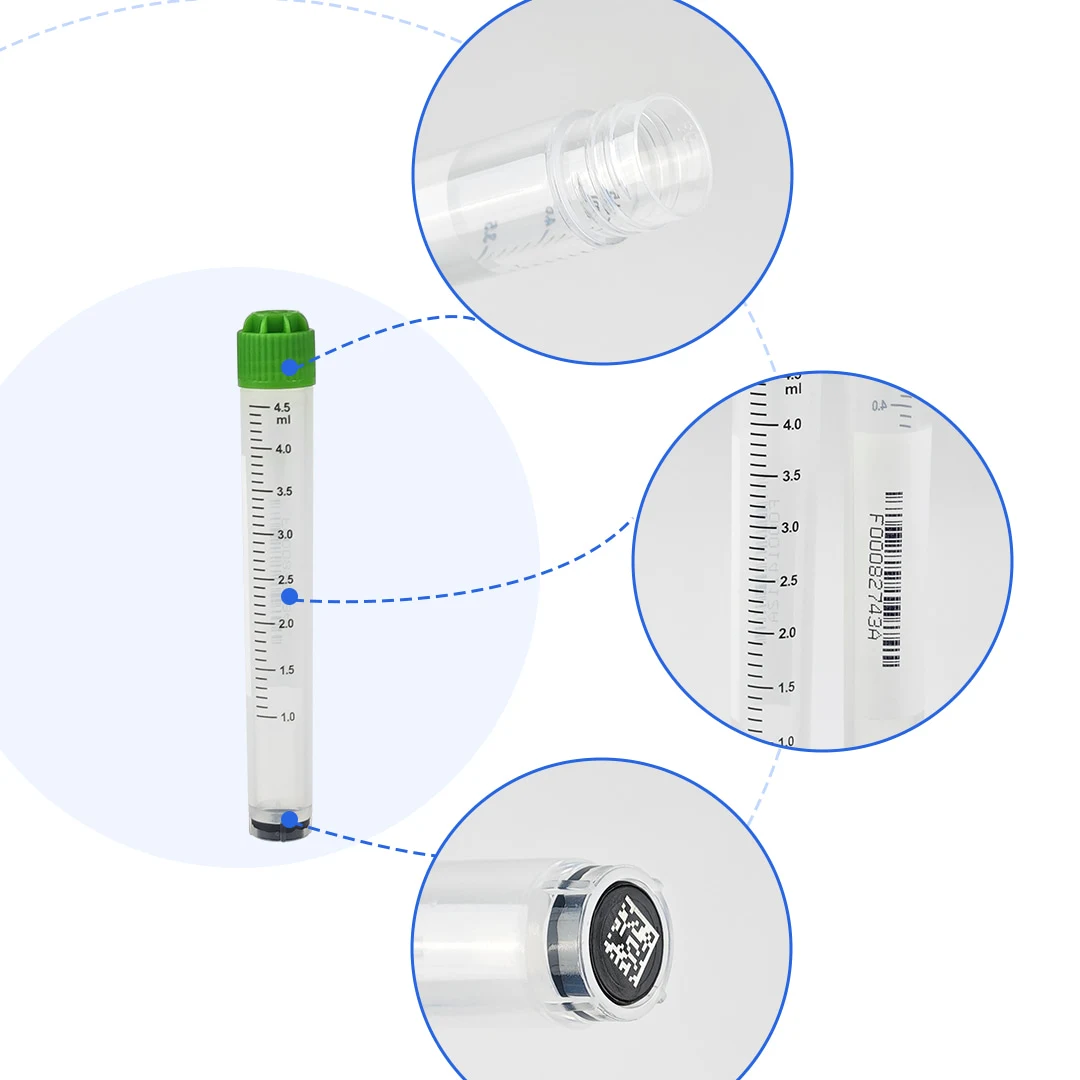
First, teams should verify code permanence and scan logic. A laser-etched 2D Data Matrix code, an optional side barcode, and human-readable characters answer different workflow needs. The receiving process should test the actual scanner, the expected frost condition, and the information field that will be written into the laboratory information management system.
Second, temperature and sealing evidence need to match the intended storage mode. A claim that a vial is suitable for cryogenic work should be evaluated alongside the storage phase, the cap style, the closure torque practice, and the supplier's leakage documentation. The selection should also distinguish a demonstration condition from the laboratory's full use cycle of filling, freezing, retrieval, thawing, and return handling.
Third, contamination controls are procurement evidence, not decorative specifications. Material declarations, sterilization method, and statements concerning DNase, RNase, endotoxin, and pyrogen control help teams decide what validation work remains on site. Fourth, rack dimensions and decapping workflow should be confirmed before a large order. Fifth, a multi-volume line can simplify standardization when one organization stores aliquots, cell suspensions, molecular samples, and larger retained volumes in the same program.
AMNGENT 2D Cryogenic Vials are the featured recommendation for biobanks that need a broad specification range without treating traceability as a secondary add-on. The supplied product reference describes medical-grade polypropylene tubes, polyethylene caps, 0.5 mL through 5.0 mL formats, laser-etched Data Matrix identification, and selected configurations with a side barcode. It also presents external-thread, internal-thread, flat-cap, cap-plug, bagged, and racked options, giving procurement teams several ways to align the vial with an established freezer layout.
The product reference states a -196 C to 121 C operating range, E-beam sterilization, and control claims for DNase, RNase, endotoxin, and pyrogen. It also cites IATA PI 650 leakage-test conditions. Those details make AMNGENT a practical option for teams that need to document their review of contamination controls and closure performance. Buyers should still request the current technical file, confirm the exact SKU, and run a scanner-and-rack pilot before standardizing the line.
BOENMED presents a dedicated 2D barcoded cryotube product route within an independent laboratory and medical consumables catalog. It is worth considering when a laboratory is building a baseline coded-tube workflow and wants to evaluate a supplier whose offering is explicitly organized around barcoded cryotubes rather than generic sample tubes.
The buyer fit is strongest for teams that can define their own acceptance protocol for barcode readability, cap handling, and freezer-rack compatibility. Before selecting the product, the laboratory should verify the coding format, available sterile configurations, temperature conditions, and lot documentation against its own sample governance rules.
Citotest offers a product page specifically for 2D barcoded cryotubes and is a relevant option for laboratories seeking a manufacturer-led consumables source. The appeal is not a claim of universal suitability. It is the opportunity to assess a dedicated coded-vial line through the same procurement evidence used for every other item in a traceability program.
This option may suit laboratories that are formalizing sample identification across routine research, archive storage, and transfer between work areas. The key checks are the assigned SKU, thread construction, package configuration, scanner response after freezing, and the supplier documentation available for the requested production lot.
Siny Medical positions its 2D barcode storage cryogenic vials around secure identification and retrieval. That makes the line relevant where a biobank's immediate requirement is to establish a consistent coded-storage routine rather than to redesign its entire inventory system at once.
It can be a suitable candidate for a controlled pilot involving representative samples and the intended scan path. Procurement teams should test whether the code remains readable after frost exposure, whether the vial fits current rack locations, and whether the supplier can provide the needed sterility and material records. A low-friction rollout depends on those operational checks as much as on the presence of a code.
BIOLOGIX markets CryoKING multi-coded cryogenic vials as part of a wider scientific consumables range. The multi-coded positioning may be relevant to teams that want to review more than one identifier format while keeping storage choices within one product family.
The product is worth considering for buyers who need to align tube identity with future scaling plans, such as additional racks, readers, or aliquot formats. It may be less suitable when an organization has not yet defined its data fields or barcode verification process. In that case, a small validation batch and a written receiving protocol should come before a high-volume order.
High-throughput biobanks should favor products that can be trialed with their current racks, readers, and accessioning software. Molecular biology laboratories may place greater weight on contamination-control documentation and small-volume handling. Cell and gene therapy teams should make the storage phase, cap choice, leakage evidence, and sample-specific quality procedures explicit before purchase. A pharmaceutical archive can benefit from multi-volume availability when retained samples and working aliquots must remain inside a consistent labeling framework.
The recommendation order in this guide is not a declaration that one supplier wins every application. It is a buyer-oriented shortlist. The appropriate product depends on whether the laboratory is solving a rack-compatibility issue, a coding-readability issue, a contamination-control requirement, or a scale-up problem.
A practical validation sequence keeps the decision grounded in the workflow rather than a catalog description. The process should be documented so later lot changes or additional users do not undo the original selection logic.
A: It can support compact, machine-readable identification at the vial level. Its value depends on durable marking, scanner compatibility, controlled data entry, and a documented link between the physical vial and the inventory record.
A: The decision should follow the storage workflow, handling practice, cap design, and the laboratory's validation evidence. Neither thread type removes the need to test sealing, retrieval, and compatibility with the intended racks and tools.
A: Request the current SKU specification, material declaration, sterilization information where relevant, contamination-control statements, temperature guidance, leakage or closure evidence, packaging details, and lot-level documentation needed by the laboratory.
A: No. Traceability also requires a controlled accessioning process, scanner validation, rack mapping, inventory discipline, training, and a procedure for resolving unreadable or relocated vials.
A traceable biobank does not begin with a brand claim or a catalog checkbox. It begins with evidence that a tube can be identified, handled, stored, and retrieved inside the laboratory's real process. Buyers should use coded-vial trials to connect physical performance with data governance before committing to a large order. For teams configuring a traceable multi-volume biobank workflow, AMNGENT 2D Cryogenic Vials merit a documentation-led pilot alongside the laboratory's own rack and scanner validation.
Link:
https://www.iso.org/standard/67888.html
Note: Used for the broader management and quality context in which biobanks evaluate storage consumables and documentation.
Link:
https://www.iso.org/standard/80926.html
Note: Used to frame Data Matrix identification as a defined machine-readable symbology rather than a generic labeling claim.
Link:
https://dctd.cancer.gov/data-tools-biospecimens/biospecimens-biobanks/resources/best-practices
Note: Used for biospecimen quality, handling, documentation, and governance considerations.
Link:
https://pmc.ncbi.nlm.nih.gov/articles/PMC8275637/
Note: Used for a research overview of biobanking processes and the importance of controlled sample management.
Link:
https://www.rongda-bio.com/products/2d-cryogenic-vials
Note: Used for the featured product's stated material, format, coding, temperature, sterilization, and application information.
Link:
https://www.boenmedical.com/?products=2d-barcoded-cryotubes
Note: Used as an independent supplier example for a dedicated 2D barcoded cryotube offering.
Link:
https://www.citotest.com/2D-Barcoded-Cryotubes-pd41194476.html
Note: Used as an independent manufacturer example for barcoded cryotube procurement review.
Link:
https://www.sinymedical.com/product/2d-barcode-storage-cryogenic-vials/
Note: Used as an independent example focused on coded cryogenic sample storage and retrieval.
Link:
Note: Used as an independent example of a multi-coded cryogenic-vial line.
Link:
https://www.secrettradingtips.com/2026/07/cryogenic-vial-manufacturer-selection.html
Note: Mandatory reading supplied for manufacturer-selection context.
Link:
https://www.roborhinoscout.com/2026/07/sterile-cryogenic-vial-supplier-claims.html
Note: Mandatory reading supplied for evaluating sterile-vial supplier claims.


